Bland Culture

Ana Carolina Calil, Brazil

Author: Ana Carolina Calil

English has come to be a global language. Nobody would deny that. However, what does it mean and what does it take for a language to reach this status? According to David Crystal (1997, 2): “A language achieves a genuinely global status when it develops a special role that is recognized in every country”.

There are around 350 million first-language speakers of English and just as many speakers of English as a second language. English has become the language of business, science, government, international communications and tourism. Speaking English became a synonym of status. In the words of the editor of the Oxford English dictionary: “… any literate educated person is in a very real sense deprived if he does not know English” (Burchfield, 1985).

As a typical middle-class Brazilian kid, I was ten years old the first time I set foot in an English classroom and seventeen when I took my first proficiency exam, and not once was the reason for my studies explained to me. I remember being dragged to class because we HAD TO learn English. It would be important for my future, whatever that meant. So, like many other children of the nineties, I spent part of my week amongst books and cassette tapes which showed a culture I knew nothing of and couldn’t get myself to relate to. When I look back, I can still remember my first textbooks “Touchdown” and “Sam on radio 321”, and how little they reflected my interests and culture. I can still sing most of the “Grammar Chants”, “Jazz Chants” and “Muzzy” songs. Continue reading Bland Culture →
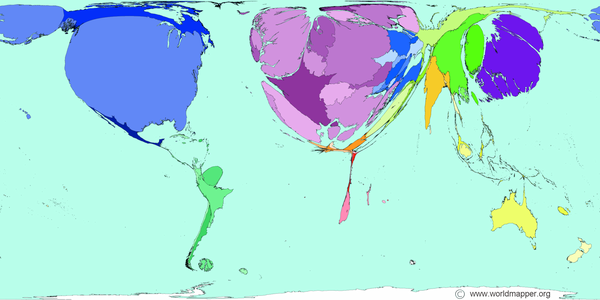
Repost: Inequitable Power, Knowledge

While we work to publish blog posts written by members of the community more regularly, we write or repost our own work as facilitators. Re-published below is an essay written by Laura Czerniewicz for the London School of Economics and Political Science blog. The article was published under a Creative Common License, and it is shared here with the author's permission. It is absolutely worth reading, especially for solutions that Laura offers to the problem of inequitable power dynamics of global knowledge production. -Current blog facilitator, Shyam

worldmapShowing “The World of Science”, the map below portrays global research production as expressed through science journals’ publishing in the early 2000s. It makes a dramatic point about the complexities of global inequalities in knowledge production and exchange. What would it take to redraw the knowledge production map to realise a vision of a more equitable and accurate world of knowledge?


Disparities

Knowledge creation and dissemination are, of course, crucially shaped by the practicalities of money and technology.  It is significant that the average R& D intensity (R&D as a percentage of GDP) for OECD countries was 2.4% in 2009, while few developing countries had reached 1% (Mjwara et al 2013). These percentages of national funds are important differentiators in what is possible; without comparable levels of support researchers in resource-poor environments must spend inordinate amounts of time fundraising and dealing with external grant-giving organisations, are limited in their ability to participate in scholarly community activities, and so are often constrained in the research they can undertake. Infrastructure also shapes what is possible; for example maps of internet cable clearly show how collaboration between those in the global north is enabled by substantial bandwidth while north-south and south-south connections are not. Continue reading Repost: Inequitable Power, Knowledge →

Repost: 8 Things about MOOCs—

While we work to share blog posts written by members of the community more regularly, we write or repost our own work as facilitators. Here's a "reprint" of a post just written by Shyam Sharma on his blog, poking fun at mainstream discourse of xMOOCs for continuing to overlook complexities due to variations in MOOC types, learners, contexts, and so on.

= = =  8 Things about MOOCs—= = =
While reading this article in the Chronicle of Higher Education, I thought about a similar number of things about MOOCs that many people in the media and the mainstream MOOCosphere seem either unable or unwilling to learn:

1. There is no such thing as MOOC, only many types of MOOCs, with many kinds of them making the original acronym sound very funny.

2. If “nearly half of registrants never engage with any of the content,” then it’s time to stop touting the “total number” of people who click on the “sign up” button.

3. If people signing up for multiple courses are most active, but even those lose interest after taking the sixth course, then there is probably something about online and massive courses that has failed to bring about magic solutions to the “crisis” in education. Continue reading Repost: 8 Things about MOOCs— →

Teaching in Nepal: Choice, Chance, and Being the Change in the World

By Praveen Yadav, Kathmandu, Nepal

Teaching, especially in schools, in Nepal is considered an easy profession. In fact, people in many other professions use teaching as a convenient start to their careers. Due to limited job opportunities, teaching is an easy way to fund higher education for young people.

So, when I was invited by a colleague at EdConteXts to share my personal and professional stories about teaching in Nepal, I did a quick survey with 72 teachers in a business college where I am working. My key question was: “Is teaching your choice or did you pick it by chance?” I wanted to know what factors affected the “choice” to become teachers.

Seventy percent of responders said that they chose teaching by chance. While those who chose teaching deliberately had studied “education” as their academic stream, those who picked this profession by chance said they did so because this was their only choice. A few colleagues chose it as hobby first and then developed an interest or even passion later on.

My Own Story of Becoming a Teacher
My own story of becoming a teacher started by chance at first.

Born and brought up in a poor family in remote rural district of Saptari, I could sense my parents struggling to send me to school as early as middle school. As pragmatic and simple village folks, they decided not to send me for further studies when I somehow finished high school. They wanted me to support my younger siblings to get a high school education.

Photo Local ContextFortunately, there was teaching! I could teach in a private school and earn my way into college. The only obstacle was that it was not easy to physically move to a place where I could receive my own further education.

But somehow, my parents allowed me to let me move ahead, even though they did not see why I needed education beyond high school. I started at the primary level and moved up to high school as I advanced in my own education. Continue reading Teaching in Nepal: Choice, Chance, and Being the Change in the World →

Bring Your Own Context: Where We Are Matters

by EdConteXts Facilitators*

Emerging academic technologies and how they allow learning and teaching across borders are all the rage. Strangely, discourses about such phenomena as open online learning/teaching usually ignore the fundamental fact that those phenomena are cross-border, cross-context, cross-cultural. It is not just the hype in the media and the grand and often false promises in the marketing of emerging modes of cross-border education that disregard the complexity of cross-border education. Even the most informed educators (in their own contexts) seem to often forget that the many different contexts from which participants and stakeholders come are not just different from each other but also diverse from within, that contextual differences and complexities need to temper our ambitions, that effective teaching and learning cannot be defined in universal terms.

In response, an increasing number of educators, scholars/writers, and other stakeholders of emerging academic technologies and pedagogies around the world are contributing their experiences, ideas, and perspectives from the ground up. Within a short period of time, the conversation that was once dominated by one-way traffic of ideas–as by the idea of education as a supply of “content”–from the few global centers to the rest of the world is quickly becoming multilateral, diverse, and rich as it spreads across the social media. The network of scholars that we are looking to create will hopefully bring together the voices of scholars, practitioners, and other stakeholders of emerging academic technologies and pedagogies from across the world. Our objective is to make visible to broader audiences what we have been writing, researching, and working on–and what we will continue to do. Continue reading Bring Your Own Context: Where We Are Matters →

Reaching: Relating & Teaching

 By Joyce Rafla, Egypt

This semester was a tough one for me. I’m starting a new job, teaching a total of 45 students in two sections of the same class (Fundamentals of Teaching & Learning for Early Years Teachers) and working on side projects. It was crazy. Aside from that, I had some “issues” with one section of the class I’m teaching. Now that the class is over, I am happy to get the chance to reflect on this semester’s teaching experience.

Teaching is Relating
I would say that my main lesson from teaching this semester is that teaching is relating. I found myself facing situations with the students similar to the ones I would face with my friends, family members, or even boyfriends! I remember standing in the middle of a feedback session, after the students communicated what they were uncomfortable with, and thinking to myself “God! This is turning into a bad relationship!” I was surprised at my own thought. That inspired me to write this blog post. Teaching and relating. I began seeing the whole teaching experience from the relationships lens. Continue reading Reaching: Relating & Teaching →

Welcome to EdConteXts

This is the home of EdContexts, an informal network and community of teachers, scholars, students, researchers, and others interested in promoting conversations about education in and across contexts around the world. You’re welcome to contribute blog posts or join us through any of the social media linked on the side.